Thank you

A Product Trainer will contact you within two business days to schedule a one-on-one training session.
This is the woman who wields power—not as a shrill stereotype, but as a complex, morally ambiguous titan. Think in The Undoing or Big Little Lies (she produced the latter specifically to create roles for herself and Reese Witherspoon). Think Glenn Close in The Wife , a slow-burn portrait of artistic servitude and explosive liberation.
But the gold standard here is in The Crown and The Lost Daughter . Colman, who came to global fame in her late 30s, plays Elizabeth II as a woman grappling with obsolescence and duty. Meanwhile, in The Lost Daughter , she plays Leda, a middle-aged academic whose messy, narcissistic, and deeply honest journey of self-discovery is the entire plot. There is no man to save her. There is no redemption arc. There is only the raw, jagged interiority of a woman who has lived. milfslikeitbig cherie deville spring cumming best
On the indie side, famously negotiated for Nomadland with a clause that required the film to be released on a large screen, not just streaming. She has also championed a "Rider" clause for inclusion on set—requiring a certain percentage of the crew to be diverse, including older women. These women aren't waiting for permission; they are writing the checks. The European and Global Standard While Hollywood plays catch-up, European and global cinema have long revered the mature woman. The French have never had this crisis. Isabelle Huppert (70) continues to play sexually aggressive, psychologically complex leads in films like Elle and The Piano Teacher re-releases. Juliette Binoche (59) remains a magnetic romantic lead in Who You Think I Am , playing a 50-something professor catfishing a younger man. This is the woman who wields power—not as
is the blueprint. After turning 30, Witherspoon realized the scripts she was sent were all "love interests for men 20 years older." Instead of complaining, she bought the rights to Gone Girl , Big Little Lies , and The Nightingale . She created a factory of prestige content for women over 40. Similarly, Nicole Kidman and her production company Blossom Films have greenlit projects specifically designed to deconstruct middle age. Sharon Horgan ( Bad Sisters , Catastrophe ) writes women who are drunk, horny, angry, and gloriously incompetent in the best way. But the gold standard here is in The
Perhaps the most terrifying twist on this is . At 60, Yeoh did her own stunts in Everything Everywhere All at Once , but more importantly, she anchored the film’s emotional core: the regret of a woman who chose laundry over love, and the cosmic power of a mother’s forgiveness. She became the first Asian woman to win the Best Actress Oscar, proving that the action hero doesn’t retire—she evolves. Behind the Camera: The Producer-Actress Revolution The current wave isn't a gift from a benevolent studio system. It is a coup orchestrated by the women themselves. The most important development in entertainment for mature women is the rise of the actor-producer.
South Korea’s won an Oscar at 73 for Minari , playing a grandmother who swears, plays cards, and steals the show. Japan’s Kirin Kiki (who passed away but remains an icon) spent her later years playing anarchic, life-affirming matriarchs in Kore-eda’s films. The lesson is clear: the American "age problem" is a cultural choice, not a biological reality. The Ripple Effect on Television If cinema is the cathedral, television is the bustling town square. The long-form series has become the natural habitat for the mature female character. Jean Smart is the current queen of this domain. At 70, she has won Emmys for two completely different roles: the cynical, predatory Vegas comedian in Hacks and the tough-as-nails crime matriarch in Mare of Easttown (she played Jean’s mother). Hacks is essential viewing because it directly confronts ageism: Deborah Vance (Smart) is a legend fighting a younger female writer who thinks her style is obsolete. The show argues that experience is not a weakness; it is a weapon.
And that is a story worth telling, for every generation.
A Product Trainer will contact you within two business days to schedule a one-on-one training session.
We’ve received your request for technical support. A Technical Support Specialist will contact you within 1 business day.
Your Target Market Request form has been sent. Your SocialCRM support agent will contact you to discuss any specifics, if needed.
Thank you for your interest in Mitchell 1 products. A Customer Service Agent will contact you within 1 business day.
Please allow 30 business days for your request to be processed.
We’ve received your request for assistance with your Mitchell 1 account. A Customer Service Agent will contact you within 1 business day.
We’ve received your request for a call back. A Customer Service Agent will contact you within 1 business day.
Thank you for contacting Mitchell 1 to discuss data integration opportunities. Clients who meet the requirements will be contacted to discuss a potential opportunity.
Your upgrade request for Accounting Link has been received. A Customer Service agent will contact you shortly.
Your details have been successfully submitted!
Direct Access—Pass-Through (transfer ticket) streamlines access straight into ProDemand Truck. Depending on the configuration, this workflow uses the user/password credentials or an account number. Your users can launch into ProDemand Truck, assuming they already have an active subscription.
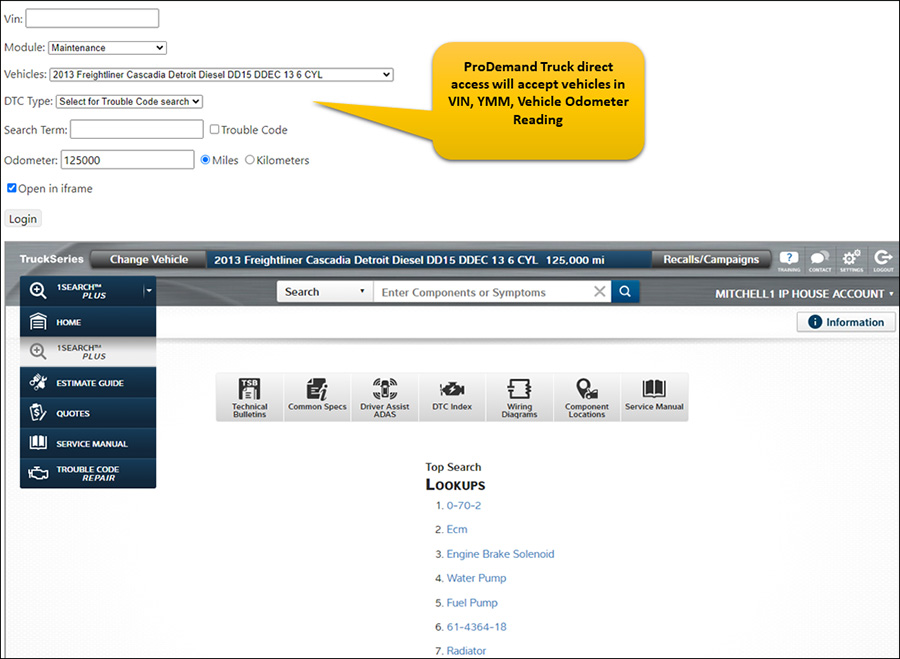
ProDemand Medium and Heavy-Duty Truck Class 4-8 has the following mechanisms for application-level integration with our repair content: (Labor)
Your users can launch the ProDemand Medium & Heavy-Duty Truck UI sub-sections, assuming they already have an active subscription.
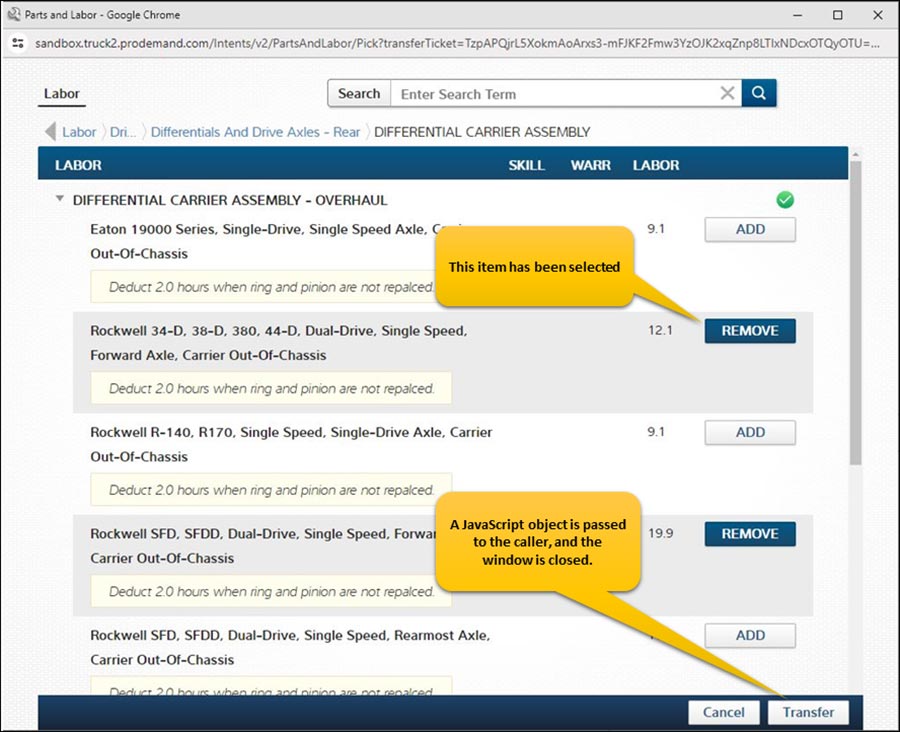
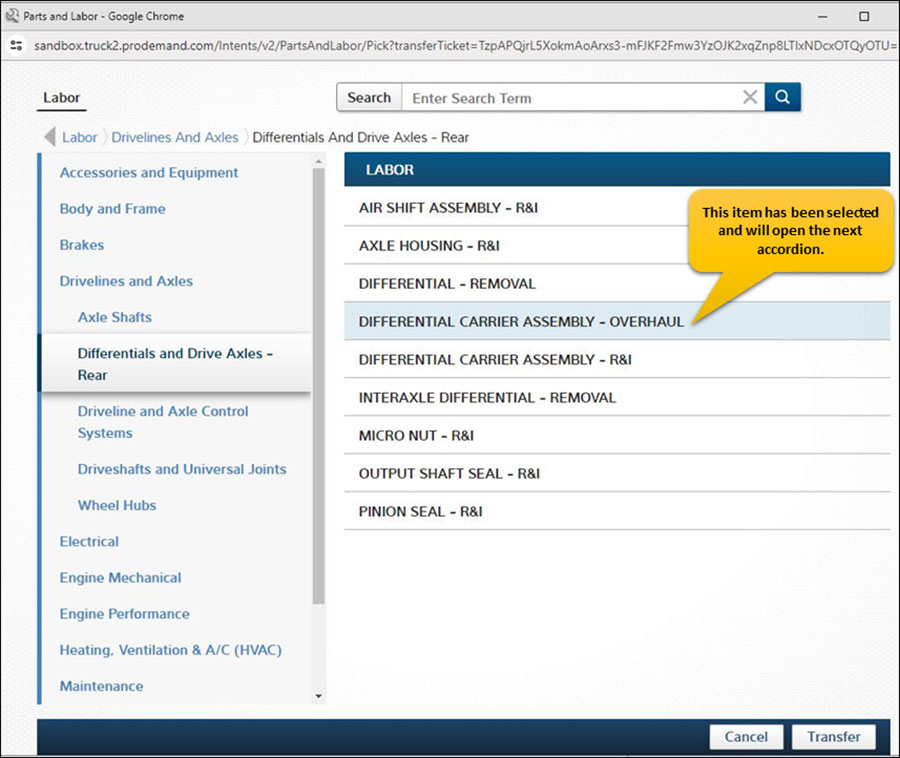
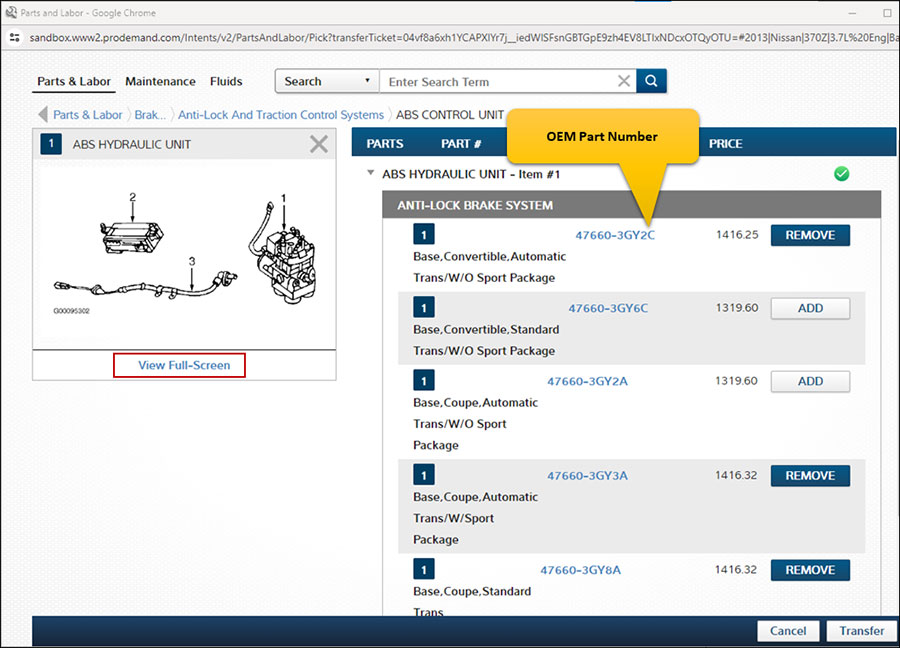
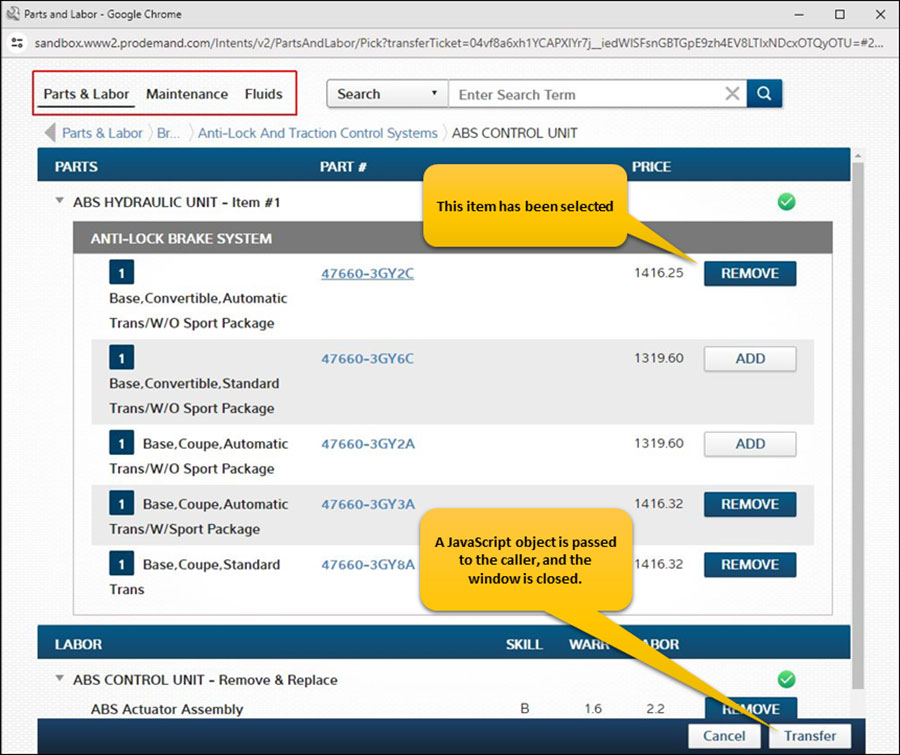
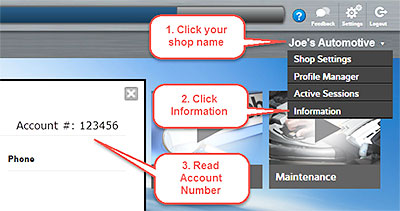
Direct Access—Pass-Through (transfer ticket) streamlines access straight into ProDemand. Depending on the configuration, this workflow uses the user/password credentials or an account number. Your users can launch into ProDemand, assuming they already have an active subscription.
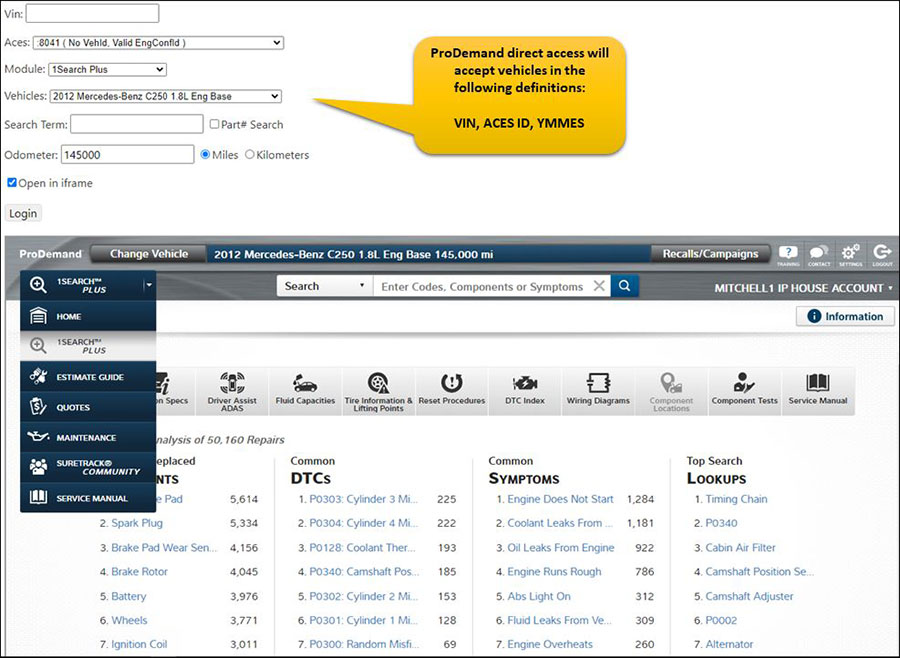
ProDemand Light Duty Automotive has the following mechanisms for application-level integration with our repair content: (Labor, Parts, Fluids, and Maintenance) Your users can launch the ProDemand Light Duty UI sub-sections, assuming they already have an active subscription.